
Kaleidocycles (Flextangles): Free Templates, Tutorials & Printable Paper Toys
Welcome to Hattifant’s wonderful world of Kaleidocycles! These fascinating paper toys combine coloring, crafting and play in one fabulous activity. Once assembled, they twist endlessly through four repeating designs, making them both mesmerizing to watch and so much fun to play with.


Whether you’re looking for a fun classroom activity, a creative rainy-day craft, an educational geometry project or simply a beautiful paper fidget toy, you’ve come to the right place.
Hattifant’s Kaleidocycle Craftiverse

Over the years, I’ve created a wonderful collection of Kaleidocycles for you to color, craft, and enjoy—from beautiful flowers and intricate mandalas to adorable animals and festive seasonal designs for Christmas, Easter, Spring, and Winter. But words can only do so much… the best way to discover the magic of a Kaleidocycle is to see one in motion!
A Kaleidocycle is a fascinating paper toy made from a ring of connected shapes that twists and turns endlessly. As you rotate it, a new picture or pattern appears with every flip, creating a mesmerizing cycle of movement that never seems to end. It’s part paper craft, part optical illusion, and completely addictive!
You may also have come across the name Flextangle. While Kaleidocycle is the mathematical name for this amazing paper model, Flextangle has become a popular name in classrooms and the paper crafting community. Whether you call it a Kaleidocycle or a Flextangle, it’s the same delightful paper toy that combines creativity, geometry, and hands-on fun.
Although Kaleidocycles have delighted paper crafters for decades, their story begins in the fascinating world of mathematics. The name Kaleidocycle is generally credited to mathematician Wallace Walker, who helped popularize these endlessly turning paper models. The name itself comes from the Greek words kalos (“beautiful”), eidos (“form”), and kyklos (“ring”)—a wonderfully fitting description for a paper model that transforms through an endless cycle of beautiful patterns.
Kaleidocycles gained widespread recognition in 1977 when Wallace Walker and Doris Schattschneider published the book M.C. Escher Kaleidocycles (affiliated link). Featuring artwork inspired by M. C. Escher, the book beautifully demonstrated how mathematics, art, and paper engineering can come together to create something both educational and mesmerizing.
Today, Kaleidocycles continue to inspire teachers, artists, mathematicians, and paper craft enthusiasts around the world. They are enjoyed as creative classroom activities, engaging geometry projects, and satisfying paper fidget toys. In fact, mathematicians are still discovering new things about them! In 2026, researchers Shota Shigetomi, Kenji Kajiwara, and Shizuo Kaji published a groundbreaking study revealing new mathematical insights into the motion of Kaleidocycles. Their work showed that these seemingly simple paper toys continue to inspire cutting-edge mathematical research, proving there’s still more to discover about their elegant and endlessly fascinating movement.
| Kaleidocycle | Flextangle |
|---|---|
| Mathematical name | Popular crafting name |
| Used in geometry | Used in classrooms and crafts |
Creating and exploring Kaleidocycles offers a fun, hands-on learning experience across a variety of subjects. As children color, fold, assemble, and play with their finished creations, they have the opportunity to:
- Develop fine motor skills through careful cutting, folding, and gluing.
- Strengthen hand-eye coordination and precision.
- Follow sequential instructions and build problem-solving skills.
- Explore geometric concepts, including shapes, symmetry, and three-dimensional forms.
- Discover how simple mathematical principles create continuous movement.
- Encourage spatial reasoning by understanding how flat templates transform into 3D models.
- Express creativity through coloring and designing unique Kaleidocycles.
- Build concentration, patience, and perseverance while assembling the paper model.
- Foster curiosity about mathematics, engineering, and paper design (STEAM learning).
- Practice visual discrimination as images and patterns change with each rotation.
- Experience the satisfaction of creating a fascinating paper toy that can be enjoyed again and again.
Choose Your Next Hattifant Kaleidocycle Adventure!
EVERGREEN & ALL YEAR AROUND

FLOWERS & MANDALAS
A beautiful collection inspired by nature and intricate patterns.


HOLIDAYS & SEASONS
Here you can choose from Spring to Winter, St. Patrick’s Day, Easter, Thanksgiving and Christmas.


ANIMAL & NATURE

Here are Kaleidocycles for movies and our heroes that we worship! They are strictly Fan Art and free to download.


I’d love to share a fun free tool with you. I don’t earn anything from recommending it—I simply think it’s too clever not to share!
On Foldplay, you can upload your own photos, drawings, or digital artwork and turn them into a completely unique kaleidocycle. It’s a wonderful way to create personalized gifts, family keepsakes, classroom projects, or just experiment with your own designs.
The finished templates aren’t quite as polished or print-ready as the ones I design here at Hattifant, but for most DIY projects it’s a fantastic (and fun!) place to start.
Go ahead and give it a try—you might be surprised by what you create!
HOW TO MAKE YOUR OWN

You will need:
- Template (choose from above)
- a Scoring tool (…to score the lines that will be folded after. You can use an old pen that doesn’t write anymore.)
- Scissors
- Glue and Tape (I tend to reinforce with tape to prevent tearing.)
- Coloring Pens (for if you choose a coloring in design)
Picture Tutorial – How To Make Your Own Kaleidocycle


- 1. Choose your Kaleidocycle template. If you have opted for a Kaleidocycle template to color then start off with coloring.
- 2. Score all vertical and diagonal lines. See the 3rd image with the red lines? All those need scoring so that the folded lines will be nice, crisp and exact.
- 3. It is time to cut out the Paper Toy.

And this is what your cut out template will look like!
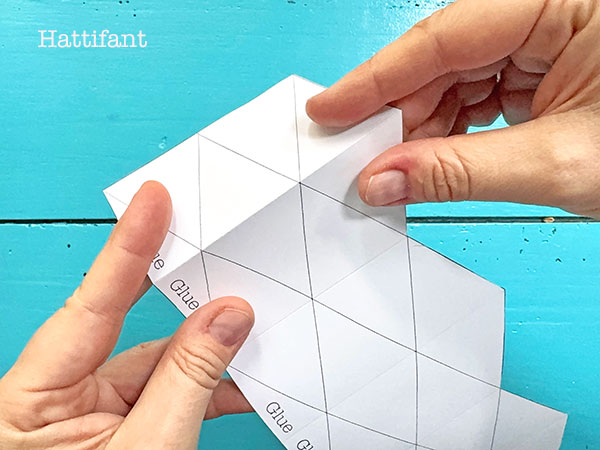


- 4. We now fold all the vertical lines forwards and backwards.
- 5. Followed by folding all diagonal lines. All the lines we scored previously we now score.
- 6. Wiggle the template into the shape of the kaleidocycle and look for the to GLUE areas.


- 7. Let’s add glue to the 3 indicated areas so we can glue together the Kaleidocycle similar to a snake.
- 8. Glue all three indicated areas together one after the other in one go. When you glued shut the snake like Kaleidocycle make sure to gently press down & wait until dry before continuing.
- Your Kaleidocycle will now look like the little paper snake in the 3rd image above.
- 9. Add glue to the indicated end part of the paper snake. Add glue to both sides (back and front).


- 10. We will glue the ends of the Kaleidocycle “snake” together.
- 11. Make sure both ends glue dry aligned. Hold tight the area that needs to stick together until dried.

Time to PLAY!
Hope you enjoyed this little tutorial, please don’t hesitate to drop a line! I always love to hear from you! It makes my day! 😉
MORE FROM HATTIFANT
Triskele Paper Globes

Foldables – Endless Cards to Color & Craft

Owl Coloring Pages

Turtle Family

Magic Mermaid World

You like Hattifant’s designs, toys & décor? Why not FOLLOW Hattifant on Facebook or Instagram and always be up-to-date with Hattifant’s latest adventures…